
Electronic invoicing
To be ready by September 2026, start today!

What is electronic invoicing ?
After introducing electronic invoicing for transactions between the private and public sectors in 2017, France is now extending this process to most economic actors in order to simplify invoice management and improve fiscal transparency.
Who is affected ?

The electronic invoicing reform comprises three separate obligations.
The obligation to receive invoices applies to all companies established in France and subject to VAT.
The obligation to issue invoices (e-invoicing) applies to all companies that:
- are subject to VAT and established in France;
- have a professional customer base (B2B) established in France;
- carry out transactions in France.
The obligation to report transactions (e-reporting) applies to businesses that:
- are subject to VAT and established in France;
- have a private customer base (BtoC);
- and/or carry out transactions abroad.
The only parties not affected by electronic invoicing are private individuals, non-commercial associations and foreign companies.
The reform timetable: the two dates that affect you
As of 1 September 2026

Large enterprises, mid-sized companies, SMEs and micro-enterprises, micro-entrepreneurs, medical professions, real estate investment companies, etc.
Receiving
Obligation to receive electronic invoices from major invoicing companies on a previously selected partner dematerialisation platform (PDP).
1 September 2027
All taxable persons established in France
Issuing
Obligation to issue electronic invoices from their PDP.
Declare their transactions international B2B and B2C.
Why do it now?
- Digitalisation is a necessity beyond electronic invoicing
- Reorganising work processes and developing internal skills can take up to 12 months
- Tools must be tested before implementation
- Your company can start reaping the benefits of electronic invoicing right now.
How does it work?
As of 1 September 2026
Receive my bills
As of 1 September 2026, you will receive invoices from your large business suppliers (EDF, Orange, OVH, etc.) on a partner dematerialisation platform (PDP).
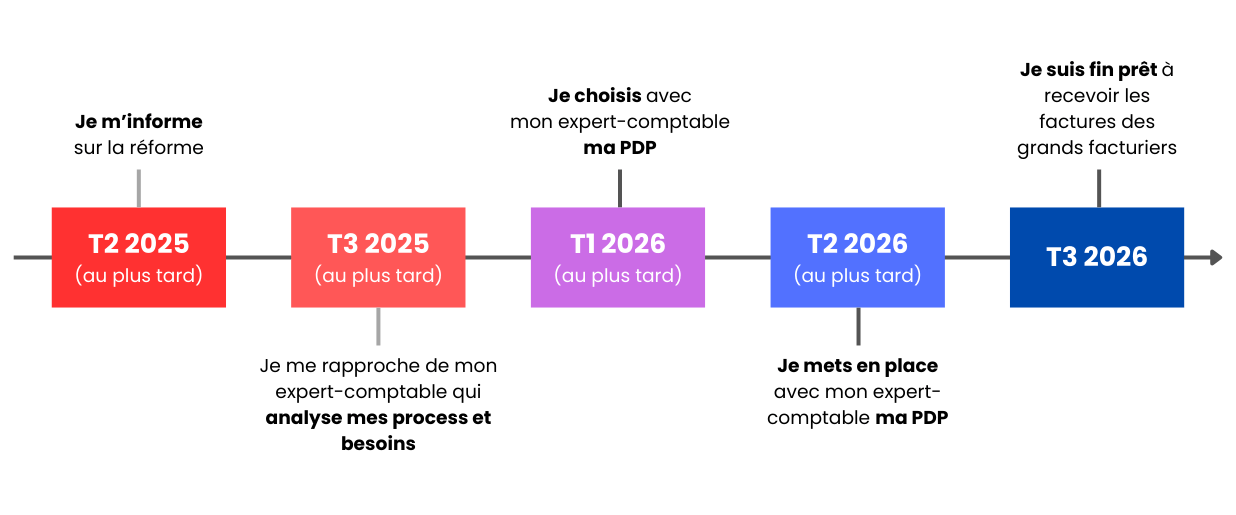
You must have chosen and subscribed to a PDP before 1 September 2026 with the advice of your chartered accountant. The contract with a PDP will be completed with a form that must be signed by the company's legal representative.
By consulting your chartered accountant, you can ensure that your choice is well suited to your company's needs.
As of 1 September 2027
Issue my invoices
In order for your customers who are subject to VAT in France to receive your invoices, you must:
- Issue your invoices in one of the three mandatory formats (Factur-X, UBL, CII)
- Ensure that you include all mandatory information on your invoices
- Send your invoices from your PDP, which should be the same one you have been using since 2026, to your customer's PDP.
Thanks to the invoice status, you will be able to monitor the processing status of the invoices you have issued on your PDP. In the event of rejection or dispute, you will be notified immediately and can resolve the issue quickly.
For services, a ‘paid’ status will allow you to pay VAT only after payment has been received.
Declaring my transactions
You must declare all sales that are NOT made to professionals to the tax authorities:
- sales and services to individuals (BtoC transactions);
- transactions with foreign companies;
- sales to non-commercial associations.
To automate these declarations, we recommend choosing a payment collection system that allows you to send your consolidated sales to your PDP platform, which will then send them to the authorities.
Receiving my invoices
In 2027, you will receive all invoices from your French suppliers on your platform.
Please note!
Take the time to assess your needs before choosing the invoicing and e-reporting software that is right for you. You have until 2027 to confirm your choice.
Do not hesitate to contact your accountant to check that all your digital solutions are compatible with each other.
How can my accountant help me?
- By auditing your invoicing system
- By supporting you in ensuring compliance and automating your tasks
- By assisting you in choosing tools suited to your business activity, digital maturity and invoicing volume
- By providing you with tools (PDP, invoicing, electronic signature, archiving, etc.)
- By taking care of certain administrative tasks (invoicing, payment, collection, invoice status tracking, etc.)

Your chartered accountant has a 360° understanding of your company's challenges and needs.
Do not choose any tools (invoicing software, cash register software, PDP) without consulting them first. This is the only way to ensure that your choices are compliant and that your data is transmitted automatically.
If not properly managed, electronic invoicing can have hidden costs. With the help of your accountant, you can avoid the additional accounting costs associated with choosing the wrong digital solutions and PDPs.
Planning for a smooth implementation
of electronic invoicing
Where can I find more information?
To learn more about electronic invoicing, check out the free resources available on the CNOEC website and YouTube channel:
> 12 short, entertaining videos to help you understand everything about the reform:
> The impacts of the reform by sector of activity:
- Hotels, Cafés and Restaurants
- Shops
- Craftspeople
- Service providers
- Associations
- Micro entrepreneurs
- Real estate sector
- Agricultural sector
- Liberal professions
- Healthcare professionals
- Pharmacies
- Holdings
- Real Estate Investment Companies
- LMNP and LMP
